CIHS in Action · Quantum AI & Consciousness
Google Quantum AI Founder Hartmut Neven Delivers CIHS Keynote on Quantum Computing and Sentience
At CIHS’s 2023 hybrid conference, Hartmut Neven, Vice President of Engineering at Google and founder of Google’s Quantum Artificial Intelligence Lab, delivered an in-person keynote on whether quantum operations may be necessary and sufficient to create sentience.
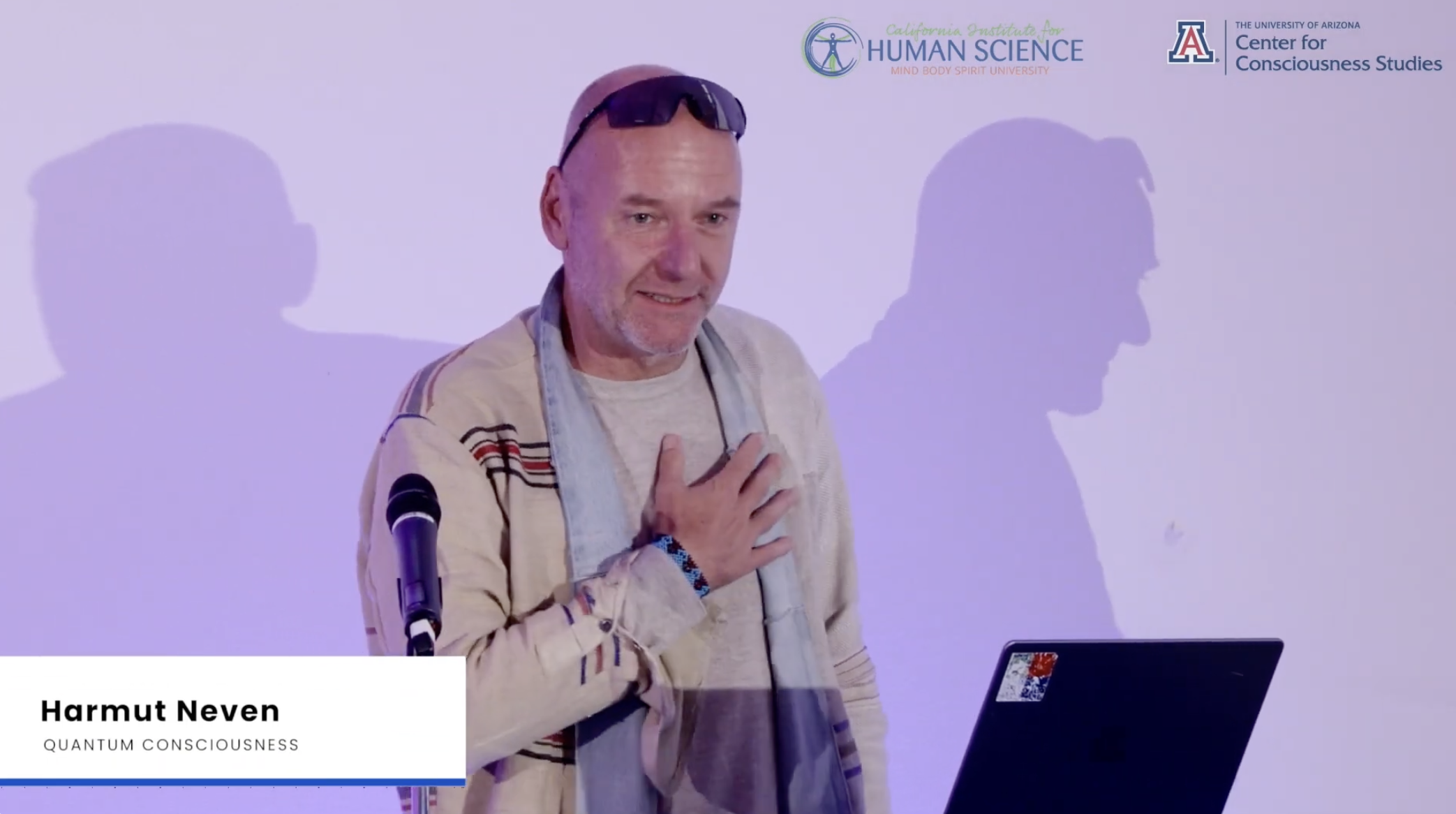
Hartmut Neven, Vice President of Engineering at Google and founder and leader of Google’s Quantum Artificial Intelligence Lab, delivering the keynote address at CIHS’s 2023 conference, Neuroscience Needs a Revolution to Understand Consciousness. Image: still from CIHS conference video.
In August 2023, California Institute for Human Science hosted the hybrid conference Neuroscience Needs a Revolution to Understand Consciousness in collaboration with the University of Arizona’s Center for Consciousness Studies. Held from the CIHS campus in Encinitas, California, the conference brought together leading voices in consciousness studies, neuroscience, physics, artificial intelligence, and philosophy for a wide-ranging inquiry into one of the most difficult questions in science: What is consciousness?
The keynote address was delivered in person at CIHS by Hartmut Neven, Vice President of Engineering at Google and founder and leader of Google’s Quantum Artificial Intelligence Lab. His talk, titled “Testing the Conjecture that Quantum Operations Are Necessary and Sufficient to Create Sentience,” proposed a bold experimental framework for investigating whether sentience may depend on quantum processes.
For CIHS, the keynote was a striking expression of the Institute’s mission. Neven’s talk connected consciousness studies with quantum computing, artificial intelligence, brain organoids, and the scientific question of sentience. It also directly anticipated the intellectual territory of CIHS’s new M.S. in Artificial General Intelligence: the intersection of AI, mind, cognition, ethics, consciousness, and the future of intelligence.
A Keynote at the Intersection of Quantum AI and Consciousness
Hartmut Neven’s keynote began from a premise that was central to the CIHS conference: contemporary neuroscience may not yet have the conceptual or experimental tools needed to fully understand consciousness. If consciousness is not merely a classical computational output of the brain, then a deeper science may be required.
Rather than treating this as only a philosophical problem, Neven framed the issue experimentally. His talk asked whether certain theories of consciousness could be tested by examining whether biological systems associated with sentience require quantum operations. The question was not simply whether the brain is mysterious, or whether consciousness feels irreducible. The question was whether a scientific protocol might be designed to test whether quantum operations are necessary and sufficient to create sentience.
That made the keynote especially important for CIHS. It brought together the Institute’s long-standing commitment to consciousness inquiry with one of the most advanced technological frontiers of our time: quantum artificial intelligence.
Who Is Hartmut Neven?
Hartmut Neven is one of the most influential figures working at the intersection of quantum computing and machine intelligence. As the founder and leader of Google’s Quantum Artificial Intelligence Lab, he has helped shape one of the world’s most visible programs in quantum computation. Google’s Quantum AI work includes the development of quantum processors and quantum algorithms designed to accelerate computational tasks relevant to machine intelligence.
In recent years, Google Quantum AI has produced some of the most widely discussed milestones in quantum computing. In 2024, Google announced its Willow quantum chip, reporting that it performed a benchmark computation in under five minutes that would take one of today’s fastest supercomputers 10 septillion years to complete. The announcement, authored by Neven, also described Willow as a major advance in quantum error correction, showing that error rates can be reduced as more qubits are added — a crucial step toward useful, large-scale quantum computing.
Neven’s background spans computer vision, machine learning, quantum computing, and artificial intelligence. This makes his appearance at CIHS especially significant. He is not approaching consciousness as a speculative outsider to technology. He is approaching it from inside one of the leading laboratories attempting to build the next generation of computational systems.
That matters because the future of artificial intelligence may not be limited to larger classical computers or more powerful neural networks. If quantum computation plays a role in future forms of machine intelligence, then the boundary between AI, physics, neuroscience, and consciousness studies becomes increasingly important.
Can Quantum Operations Create Sentience?
The title of Neven’s keynote asks a radical question: Are quantum operations necessary and sufficient to create sentience?
The phrase “necessary and sufficient” matters. To say quantum operations are necessary would mean that sentience cannot arise without them. To say they are sufficient would mean that, under the right conditions, quantum operations could generate sentience. These are enormous claims. But Neven’s keynote did not simply assert them. It explored how one might begin testing such a conjecture.
Consciousness is often treated as uniquely resistant to experiment because subjective experience cannot be directly observed from the outside. We can measure brain activity, behavior, language, reaction time, and neural signals, but we cannot simply look at another system and directly see its inner experience.
Neven acknowledged this challenge while pointing toward a possible experimental opening. If a biological system associated with consciousness can be coupled to quantum systems in a precise way, then it may become possible to test whether that biological system is operating in a manner that requires a quantum mechanical description.
In this way, the talk moved beyond abstract debate. It asked whether the problem of consciousness might be approached through experimental systems that connect quantum devices, biological substrates, and measurable physical effects.
A Proposed Test for Quantum Processes in the Brain
A central part of Neven’s keynote involved designing a hypothetical experiment to test whether a biological substrate associated with consciousness can mediate quantum entanglement.
In simplified form, the proposed logic is this: imagine two quantum systems that are not directly entangled with one another. If both are coupled to a biological system, and the two quantum systems later show evidence of entanglement, this could suggest that the biological system itself must be described quantum mechanically. In other words, the biological system would not merely be a classical object passively interacting with quantum devices. It would be participating in a quantum process.
This does not prove consciousness in one step. It does something more precise and experimentally meaningful: it asks whether certain physical operations that may be relevant to consciousness are quantum in nature. That is the kind of question a scientific experiment can begin to address.
Neven proposed brain organoids as a possible experimental platform. Brain organoids are three-dimensional biological structures grown from neural tissue that can model aspects of brain organization and activity. They can be measured and connected to experimental apparatus in ways that make them potentially useful for testing hypotheses about neural and quantum processes.
Neven also explored how quantum systems might be coupled to biological tissue through carefully chosen physical degrees of freedom. One example involved xenon isotopes, which differ in mass, nuclear spin, and anesthetic potency. Because anesthesia is closely connected to questions of consciousness and its interruption, xenon provides a possible experimental handle for probing whether nuclear spin or other quantum properties might play a role in brain tissue.
The deeper implication of the keynote was that the long-standing debate over quantum consciousness may become experimentally addressable. Instead of asking only whether quantum theories of consciousness are philosophically attractive, Neven asked whether one could design an experiment to test whether neural or neural-like systems actually require quantum computation.
Why This Matters for CIHS
Neven’s keynote fit directly within the title of the CIHS conference: Neuroscience Needs a Revolution to Understand Consciousness. The talk suggested that such a revolution may involve more than neuroscience alone. It may require quantum physics, computer science, biological modeling, artificial intelligence, and new forms of experimental design.
This is precisely the kind of transdisciplinary inquiry CIHS exists to support. Since its founding, CIHS has sought to bring together scientific research, consciousness studies, spirituality, subtle energy inquiry, and human transformation. Neven’s keynote demonstrates that these questions are not marginal or outdated. They are increasingly central to some of the most advanced scientific and technological research of the 21st century.
For CIHS students, the keynote also offered a model of intellectual courage. Neven did not treat consciousness as a solved problem, nor did he reduce it to conventional neural computation. Instead, he asked whether new tools from quantum technology could help us test one of the deepest questions in science: what kinds of physical processes are capable of giving rise to sentience?
A Bridge to CIHS’s M.S. in Artificial General Intelligence
The keynote has special significance for CIHS’s new M.S. in Artificial General Intelligence. The program explores AI, mind, cognition, consciousness, ethics, AGI safety, and responsible innovation. Neven’s talk sits directly within that emerging field.
As artificial intelligence systems become more powerful, questions of consciousness and sentience will become increasingly urgent. Are advanced AI systems merely processing information, or could they ever become conscious? Is sentience a matter of computation, embodiment, biological organization, quantum processes, or something else? What kinds of systems could, even in principle, possess subjective experience?
These questions cannot be answered by computer science alone. They require philosophy of mind, neuroscience, cognitive science, physics, ethics, and consciousness studies. That is exactly the kind of integrative field CIHS is building.
By hosting Hartmut Neven’s keynote on quantum operations and sentience, CIHS positioned itself within a global conversation about the future of intelligence. The event shows that CIHS is not only preserving a tradition of consciousness inquiry; it is helping bring that inquiry into dialogue with the most advanced developments in AI and quantum computing.
Watch the Keynote
Hartmut Neven’s CIHS keynote, “Testing the Conjecture that Quantum Operations Are Necessary and Sufficient to Create Sentience,” is available to watch online.
Study Artificial General Intelligence and Consciousness at CIHS
California Institute for Human Science offers graduate programs for students drawn to the deepest questions of mind, consciousness, science, technology, healing, and human development.
Explore the M.S. in AGI