
CIHS in Action · Consciousness Conference
Nobel Laureate Sir Roger Penrose Lectures on Consciousness at CIHS
At the August 2023 hybrid conference Neuroscience Needs a Revolution to Understand Consciousness, Sir Roger Penrose joined remotely from Oxford to explore consciousness, retrocausation, and the timing of conscious action.
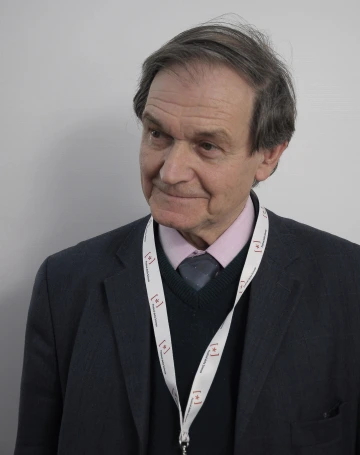
Sir Roger Penrose, Nobel Laureate in Physics and Emeritus Rouse Ball Professor of Mathematics at the University of Oxford. Photo: Cirone-Musi / Festival della Scienza, CC BY-SA 2.0.
In August 2023, California Institute for Human Science hosted the hybrid conference Neuroscience Needs a Revolution to Understand Consciousness in collaboration with the University of Arizona’s Center for Consciousness Studies. Held from the CIHS campus in Encinitas, California, the conference brought together speakers and participants both in person and online for a wide-ranging inquiry into one of the most difficult and consequential questions in science: What is consciousness?
Among the featured speakers was Sir Roger Penrose, Nobel Laureate in Physics and Emeritus Rouse Ball Professor of Mathematics at the University of Oxford. Joining remotely from Oxford, Penrose delivered a lecture titled “On the Timing of Conscious Experience and Consciously Controlled Actions.”
For CIHS, the event represented more than a distinguished public lecture. Penrose’s work stands at the threshold between physics, mathematics, philosophy, neuroscience, and consciousness studies. His lecture invited the CIHS community into a form of inquiry that is scientifically serious, philosophically daring, and open to the possibility that consciousness may require a more expansive science than the one we have inherited.
A Nobel Laureate at the Frontiers of Physics and Mind
Sir Roger Penrose received the 2020 Nobel Prize in Physics for his groundbreaking work on black holes. His Nobel-winning contribution showed that black-hole formation is not merely a speculative possibility, but a robust prediction of Einstein’s general theory of relativity. In the 1960s, Penrose developed powerful mathematical methods for understanding gravitational collapse, singularities, and the deep structure of space-time. His work helped transform black holes from mathematical curiosities into central objects of modern physics and cosmology.
Yet Penrose’s influence reaches far beyond black-hole theory. Over the course of his career, he has also become one of the most provocative and original scientific voices in consciousness studies. His work asks whether consciousness can be fully explained through classical computation, or whether the phenomenon of mind may require new physics.
That question sits at the heart of CIHS’s mission. If human beings are not merely biological machines, and if consciousness cannot be reduced to matter as conventionally understood, then science itself must expand. Penrose’s work asks whether the study of consciousness may require new concepts at the boundary of physics, biology, mathematics, and lived experience.
From The Emperor’s New Mind to the Science of Consciousness
Penrose’s major public intervention into consciousness studies began with his 1989 book The Emperor’s New Mind: Concerning Computers, Minds, and the Laws of Physics. In that book, Penrose challenged the assumption that the human mind is simply a kind of computer, or that human understanding can be fully modeled by an algorithmic machine.
The book ranges widely across artificial intelligence, mathematics, Gödel’s incompleteness theorems, physics, cosmology, quantum mechanics, and philosophy of mind. At its center is a bold argument: human consciousness and genuine understanding may involve processes that are not reducible to conventional computation. Penrose did not merely argue that current computers are not conscious; he questioned whether any purely algorithmic system, even in principle, could capture the full nature of human insight, mathematical understanding, and conscious awareness.
This was a radical claim, especially at a time when strong artificial intelligence and computational models of mind were gaining cultural and scientific momentum. Penrose opened a different path: perhaps consciousness is not simply something the brain computes, but something rooted in a deeper layer of physical reality.
The Emergence of Orch OR
Penrose’s early work on consciousness eventually evolved into the theory now known as Orchestrated Objective Reduction, or Orch OR, developed in collaboration with Dr. Stuart Hameroff, an anesthesiologist and consciousness researcher at the University of Arizona.
The theory brings together Penrose’s ideas about quantum state reduction and non-computable physical processes with Hameroff’s research on microtubules, the tiny structural components inside cells, including neurons. In broad terms, Orch OR proposes that consciousness arises through orchestrated quantum processes within neuronal microtubules, and that moments of conscious experience may be associated with objective reductions of quantum states.
In this view, consciousness is not treated as a mere byproduct of classical neural computation. Instead, it is approached as a phenomenon potentially connected to quantum processes, the structure of space-time, and biological organization within the brain. The theory remains debated, but it has become one of the most widely discussed and provocative models in contemporary consciousness studies.
This is precisely why Penrose’s work matters so deeply to CIHS. Whether one accepts, questions, or critiques Orch OR, the theory asks the kind of fundamental questions that define the field: What is the relationship between mind and matter? Is consciousness computational? Does subjective experience require new physics? How should scientific inquiry approach phenomena that do not fit neatly within inherited categories?
Consciousness, Time, and Human Action
In his CIHS lecture, “On the Timing of Conscious Experience and Consciously Controlled Actions,” Penrose explored one of the most puzzling aspects of consciousness: the relationship between conscious experience, time, and action.
Ordinarily, we assume that conscious intention comes first, and bodily action follows. But the timing of conscious awareness and voluntary action has long raised difficult questions in neuroscience and philosophy. How quickly can conscious decisions occur? When does conscious intention arise? Is consciousness simply observing actions already initiated by the brain, or does it play a deeper causal role?
Penrose approached these questions through the lens of quantum mechanics and the possibility of retrocausation. In ordinary common sense, causation runs from past to future. But certain structures and interpretations within quantum theory suggest that the relationship between past and future may be more subtle. Penrose explored whether retrocausal processes could help illuminate how conscious action occurs in real time.
One of the examples he discussed was the astonishing speed of athletic reaction. In fast-moving sports such as ping pong, players appear to perceive, decide, and act in intervals so brief that ordinary models of conscious deliberation seem inadequate. Penrose, who noted that he had played ping pong himself, used this kind of example to ask whether consciousness and action may involve a more complex temporal structure than linear cause-and-effect models allow.
The point is not merely that athletes react quickly. The deeper question is whether conscious control, bodily intelligence, and timing might reveal something still unknown about the nature of consciousness itself. If conscious experience is not simply a late-arriving byproduct of neural processing, then science may need new models for understanding agency, perception, and action.
A CIHS Conversation at the Frontier
Penrose’s lecture fit directly within the theme of the CIHS conference: Neuroscience Needs a Revolution to Understand Consciousness. The title itself points toward the Institute’s deepest orientation. CIHS exists to ask whether the dominant frameworks of modern knowledge are sufficient to understand the full range of human experience, or whether a more creative and integrative science is needed.
This question is not abstract for CIHS. It is built into the Institute’s founding mission. Dr. Hiroshi Motoyama envisioned CIHS as a place where science and spirituality could meet without reducing one to the other. Principle 8, calling for “a creative science that researches the mind and soul as well as matter,” remains one of the clearest expressions of that mission.
Penrose’s work offers a powerful example of such creative science. His Nobel-winning work helped reshape modern physics. His work on consciousness challenges the assumption that mind can be explained by computation alone. His collaboration with Hameroff proposes that consciousness may involve quantum processes within the living brain. And his CIHS lecture invited students, faculty, researchers, and the wider public to consider whether time, causation, and consciousness are more deeply intertwined than conventional models allow.
For students in Integral Noetic Sciences, Psychology, Integral Health, and Artificial General Intelligence, Penrose’s work offers a model of intellectual courage: the willingness to question dominant assumptions, cross disciplinary boundaries, and ask whether consciousness may require a deeper science than the one we have inherited.
Watch the Lecture
Sir Roger Penrose’s CIHS lecture, “On the Timing of Conscious Experience and Consciously Controlled Actions,” is available to watch online.
Study Consciousness at CIHS
California Institute for Human Science offers graduate programs for students drawn to the deepest questions of mind, body, spirit, science, technology, healing, and human development.
Explore Graduate Programs